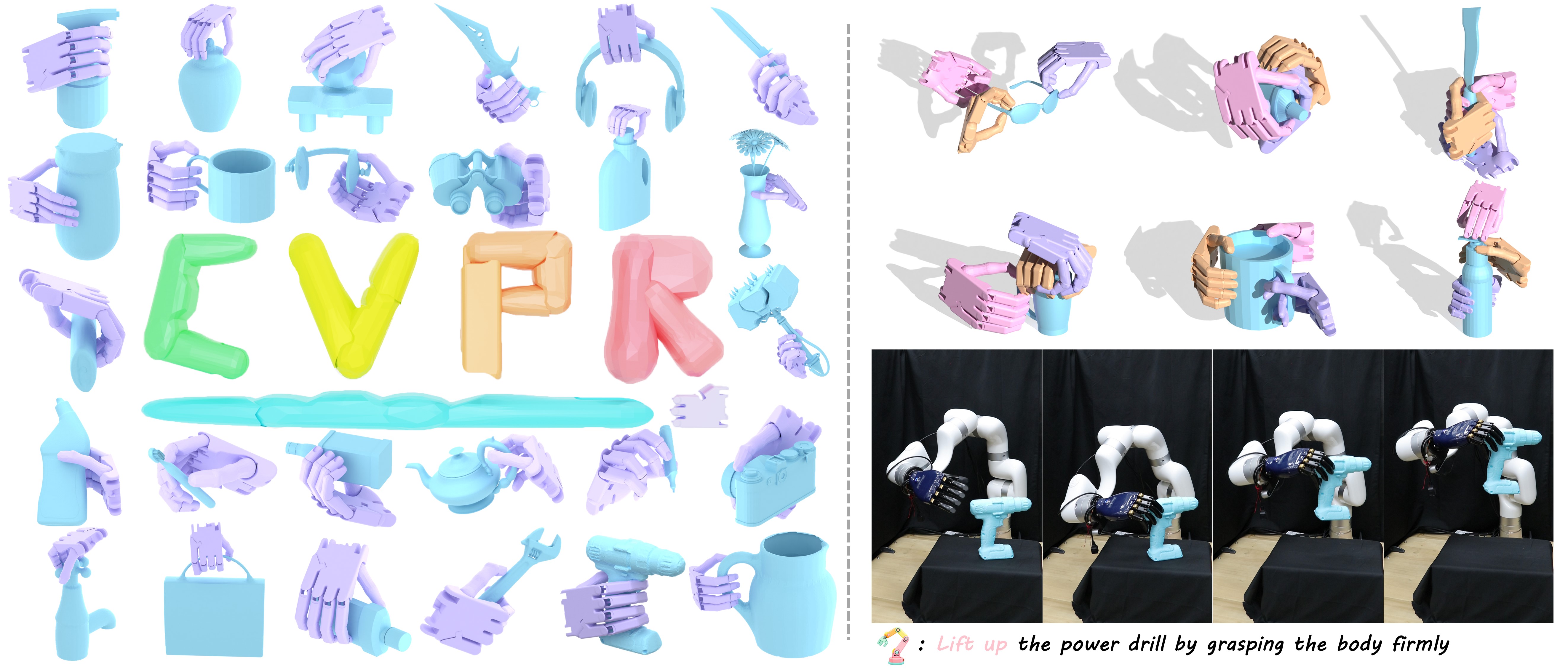
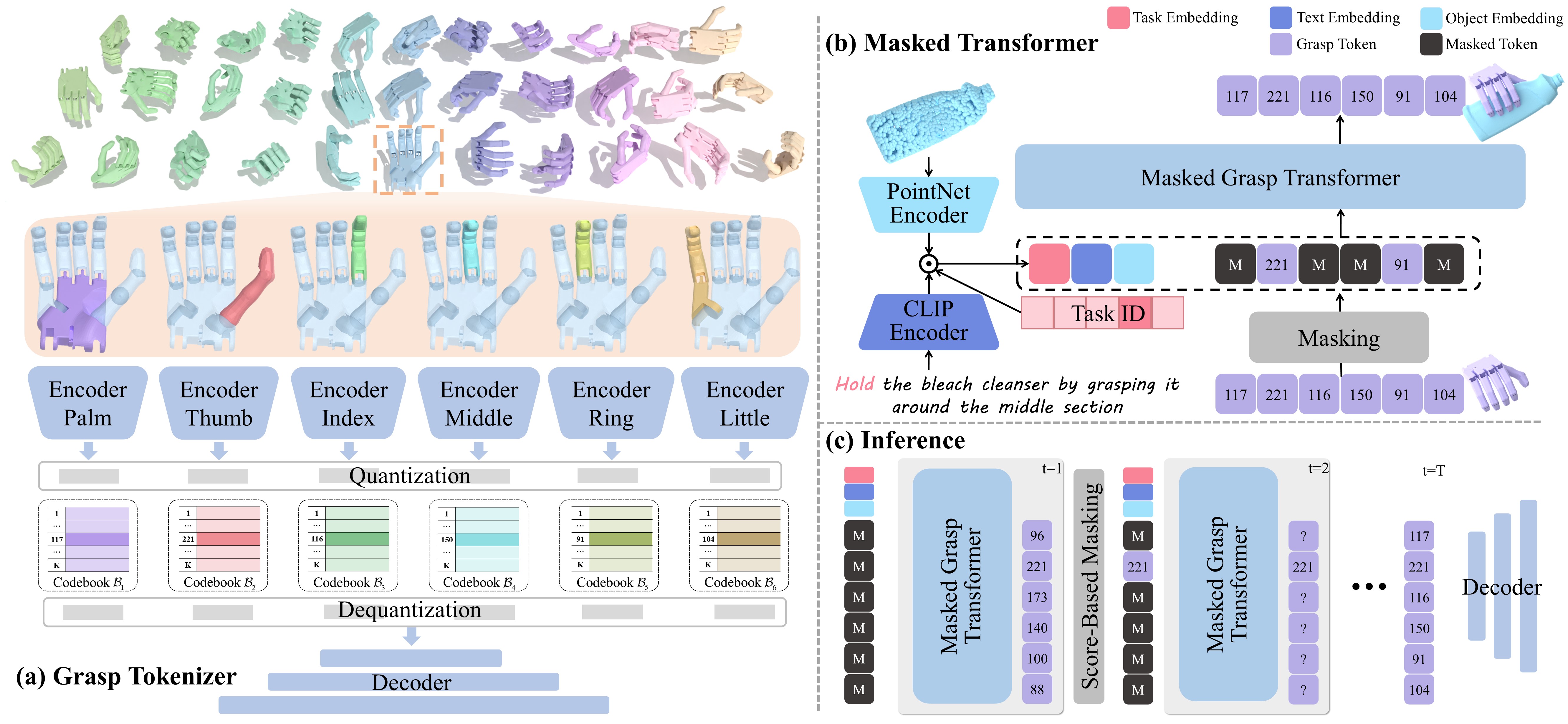
Abstract
Dexterous grasp generation is a predominant task that enables robots to perform human-level manipulation. However, a dexterous hand always maintains high-dimensional DoF and actuation space, making existing approaches that rely on holistic latent representations difficult to produce high-quality and semantically aligned grasps. In this paper, we propose MaskDexGrasp to address these challenges. We first present a part-aware grasp tokenizer that decomposes dexterous grasps into discrete tokens, facilitating compositional modeling of anatomical dependencies. Building upon this representation, a bidirectional masked grasp transformer is then developed to predict grasp tokens conditioned on object geometry and task description, ensuring coherent grasp generation while allowing fine-grained part-level editing. To facilitate evaluation, we construct a dexterous grasp dataset that comprises 65K grasping instances and 260K richly annotated descriptions covering 11 tasks. Comprehensive experiments demonstrate that our method achieves the state-of-the-art performance. Our code and dataset will be released upon acceptance.